
Imagine you run a training institute and your ad is live. One person asks when the next cohort starts, another messages on WhatsApp about instalments, and a third asks for a call after work. At six o’clock, your sales rep is answering new enquiries, your enrolment officer is checking bank transfers, and ten prospects are still waiting for the follow-up they were due today. By month-end, enrolments are below target. Should you raise the budget? Here’s the first question we’d ask at Marktone: If twenty more enquiries came in tomorrow, who would follow up with each person, and when?
That doesn’t mean the ad is blameless or the team is underperforming. The campaign may attract the wrong audience, the offer may be unclear, or the team may not have time to follow through. Before you spend more, use the numbers to work out which of the three needs attention.
Follow the enquiry through to enrolment, not just the lead count
Start by grouping the opportunities received in a single period, such as one week. Track those same opportunities until prospects have had a realistic amount of time to decide whether to enrol in your course. Don’t compare this week’s enquiries with this week’s payments: some of those payments may come from people who enquired two weeks ago, and people who enquired this week may still be deciding. Treat results as provisional until the follow-up window closes.
• Genuine enquiry: A form received by your system, an incoming WhatsApp message, or a call with a clear request. A click on the WhatsApp button isn’t a message. Consolidate channels, exclude tests and spam, and merge repeat contacts from the same person about the same programme.
• Human response attempt: A call or a reply that helps the prospect, with a recorded timestamp. An automated acknowledgement is useful, but it doesn’t answer their question.
• Successful contact: The prospect replied or had an actual conversation with the team. An outbound call alone does not count.
• Qualified opportunity: The programme, delivery mode and cohort dates fit the prospect’s needs, and they meet the applicable entry requirements. Set these criteria in advance. Don’t mark someone as unqualified simply because you couldn’t reach them.
• Paid enrolment: Payment is confirmed in your system. A payment link or a promise to pay doesn’t count. Agree how you will record deposits and refunds, so the definition stays consistent between periods.
Record each opportunity’s source only as far as the evidence goes: the platform, campaign or ad, if that information came through with the enquiry or can be reliably linked to it. If the source is unknown, leave it unknown. Don’t attribute an enquiry to an ad simply because both showed up on the same day.
Example: 100 enquiries, four steps to paid enrolment
The numbers below are illustrative. They aren’t client results or market benchmarks. Suppose a training institute spent SAR 4,000 on a campaign and linked 100 genuine enquiries from one week to it after removing duplicates and verifying their source. When the follow-up window for that group closed, the results looked like this:
| Stage | Count | Share of previous stage |
|---|---|---|
| Genuine enquiries linked to the campaign | 100 | Starting group |
| Received a human response attempt | 80 | 80% |
| Successfully contacted | 60 | 75% |
| Qualified for the programme | 30 | 50% |
| Confirmed paid enrolments | 9 | 30% |
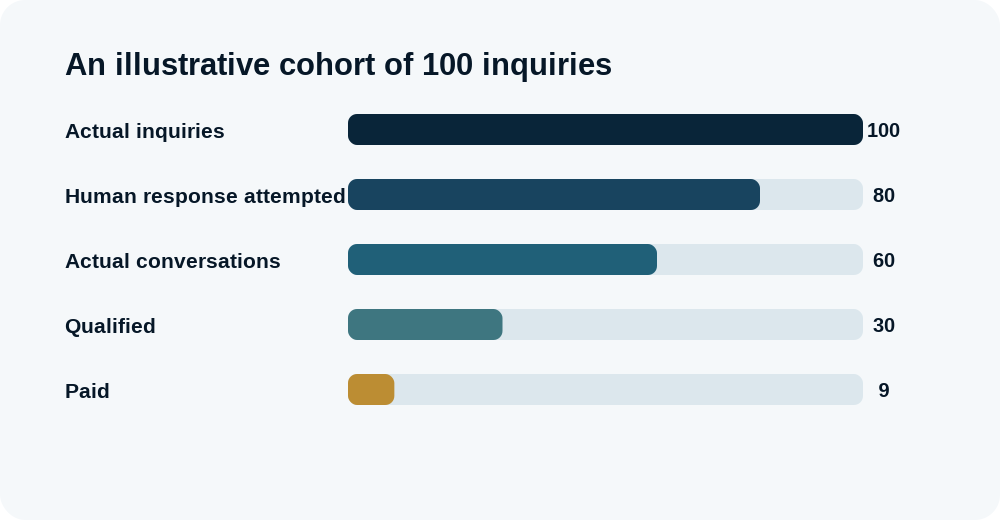
The campaign cost SAR 40 per enquiry but around SAR 444 per paid enrolment in ad spend alone, before sales and operating costs. Cost per enquiry is not enough to judge whether a campaign makes financial sense.
Before you increase spend, look at the twenty records without a human response attempt. Were they left unassigned? Did they arrive after hours? Was the number incorrect? Then review some of the prospects you reached who didn’t qualify. Did the ad promise different dates or a different way to attend? If qualified prospects keep dropping out, look at barriers such as unclear pricing, the payment link or follow-up that didn’t happen as agreed. Keep the possible causes separate. And don’t assume that fixing the missed responses will produce enrolments at the same 9% rate. Test the fix and measure what happens.
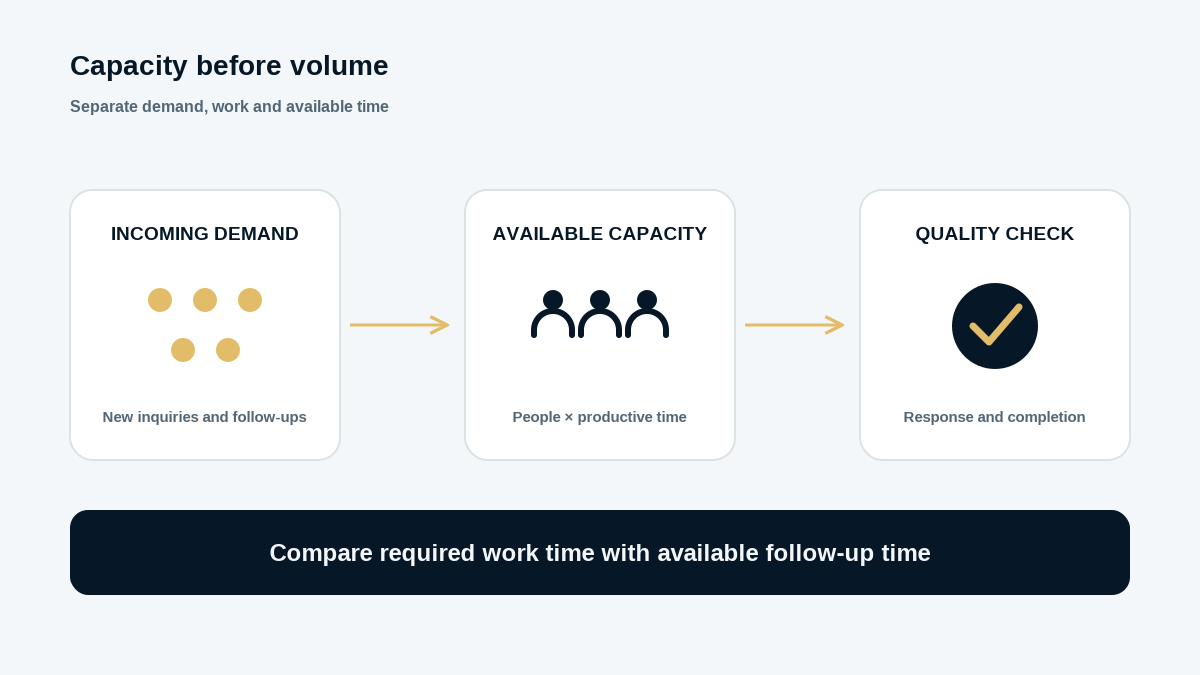
Sales follow-up capacity calculator
Use time actually available for sales follow-up, not paid shift hours. Check peak workloads separately; daily averages can hide them.
Calculate capacity in minutes, then test it at peak time
The number of people on your team and their working hours don’t tell you how much time they can spend following up. Subtract meetings, breaks, enrolment and admissions work, learner support and any other responsibilities. Use your records to estimate the time spent on each opportunity across its full journey: reading the enquiry, responding, following up and updating the record. Look at peak periods separately. Spreading a day’s workload over eight hours on paper can hide a queue that builds up in two.
Illustrative daily example under steady operating conditions:
• Two staff members each have 210 minutes a day for sales and follow-up after other tasks are deducted: 420 minutes.
• Reserve 60 minutes for unexpected work and fluctuations in enquiries: 360 minutes for planning.
• A new enquiry creates 18 minutes of work on average across its follow-up window: 7 for the first response, 8 on average for follow-ups, and 3 for documentation and handover.
• Approximate planning capacity: 360 ÷ 18 = 20 new enquiries a day. Routine follow-ups are already in the 18 minutes, so don’t count them again. If you have an unusual backlog, temporarily deduct the time needed to clear it from the 360 minutes.
If you average 17 enquiries a day, you have theoretical room for just three more. If 13 arrive in two hours and you have 60 actual minutes for first responses at 7 minutes per response, you can start responding to about eight within those two hours. Five will still be waiting, even if the daily average looks manageable. If that wait exceeds your response commitment, fix peak coverage first. This is a planning estimate, not a promise of daily performance. Revisit it using your team’s records, especially when enrolment opens and when a cohort is about to start.
Give every opportunity an owner and a next step with a due date
You don’t need a separate department for every role. In a small institute one person may wear several hats, but you still need to know who owns the task now and who takes it next:
| Role | Responsibility | What to hand over |
|---|---|---|
| Marketing | Make sure the ad reflects the dates, delivery mode and requirements; tag the source | The opportunity and its source, including the ad or campaign if verified |
| Enquiry intake | Consolidate incoming enquiries, remove duplicates, respond or route, assign an owner | One record with a deadline for the next step |
| Sales | Qualify the need, explain the offer, address objections and confirm the next step with the prospect | The current stage, why it is there and the agreed next step |
| Enrolment and admissions | Check entry requirements and documents, confirm payment and reserve the place | Confirmed enrolment or the issue that needs attention |
| Supervisor | Monitor overdue follow-ups and peak coverage, and sample response quality | A decision: fix the offer, redistribute work or extend coverage |
Before each shift ends, check three lists: unassigned opportunities, overdue next steps and payments awaiting enrolment confirmation. If the problem is the handover between two people, hiring another person may only add another handover without shortening the wait.
Run this audit this week
1. Map the process in a day. Take the most recent complete week of incoming enquiries. Put form submissions, WhatsApp messages and calls into one log and check for duplicates. Record when each enquiry arrived, when someone first tried to respond, when contact was made, its current stage, its owner and the next step. Collect only the data you need.
2. Test each handover from start to finish. Use clearly labelled test data from each active channel and test at two different times. Did the enquiry appear once? Was an owner assigned and follow-up scheduled? Did the source tags make it to the record? Keep test entries out of sales and conversion metrics.
3. Review delayed and lost opportunities. Sample several channels and programmes. Record the times queues build and the reasons opportunities stalled, based on the records rather than assumptions. If the median response time looks good but some enquiries wait too long, look at the response time within which 90% of responded-to enquiries received a reply. Report the share that never received a reply alongside it so those enquiries don’t disappear from the measurement.
4. Set an internal standard, not a target borrowed from the internet. Agree on a realistic response commitment for working hours and after hours, a backup owner and the point at which an enquiry should be escalated. Test the plan in a normal week and on a peak day. Don’t make follow-up depend on someone’s memory.
5. Change one thing and compare. If queues are the problem, try a shift that covers the peak before changing the ad. If most of the people you reach aren’t a fit, fix the ad’s promise and targeting before expanding the team. If qualified prospects stall at payment or seat confirmation, fix that step first. Where possible, compare two groups that have had the same amount of follow-up time.
When does increasing the budget make sense?
When you know the ad cost per paid enrolment for a campaign you can reliably attribute, it fits within the programme’s contribution after direct costs that rise with each enrolment, and your team’s records show spare capacity at peak times. Check the cohort’s fixed costs and the minimum enrolment needed to run it, too. A positive contribution on one seat doesn’t make the cohort profitable. Start with a limited increase, run it long enough to see a full follow-up cycle, and decide in advance when to roll it back: for example, if unassigned next steps accumulate, you miss your response commitment, or the cost per enrolment exceeds your ceiling. If you haven’t seen enough enquiries, extend the test rather than declaring victory after a single enrolment.
To review the advertising provider’s own performance, see How to evaluate a marketing agency’s performance. If you need to bring opportunity records from different channels into one place, see the CRM guide for training providers.
If you’re still working out delivery costs, see How to decide whether to launch a training course. If follow-up is getting stuck because prospects expect a different way to attend, read Choosing a training delivery mode in Saudi Arabia.
Next step: Sample a single week and identify where opportunities stopped: before the first response, during qualification, or after payment instructions were sent. If the issue is enquiry coverage and follow-up, explore Sales and customer service teams for Saudi training centres and institutes. If the bottleneck is routing enquiries and connecting channels, start with Operations improvement and technology solutions.