
A cohort can be unprofitable on paper and still cost less to run than to cancel. The difference is between two questions: How many seats cover the full cost of the cohort? And how much do you stand to lose from today if you run, postpone, or cancel?
Suppose you have 20 names on the booking list but only eight have paid. Do not assume the other 12 will pay, or cancel just because the number is below target. Start with the payment ledger and compare your options at the last point at which you can still change course without disadvantaging learners.
First decision: How many seats cover the full cost of the cohort?
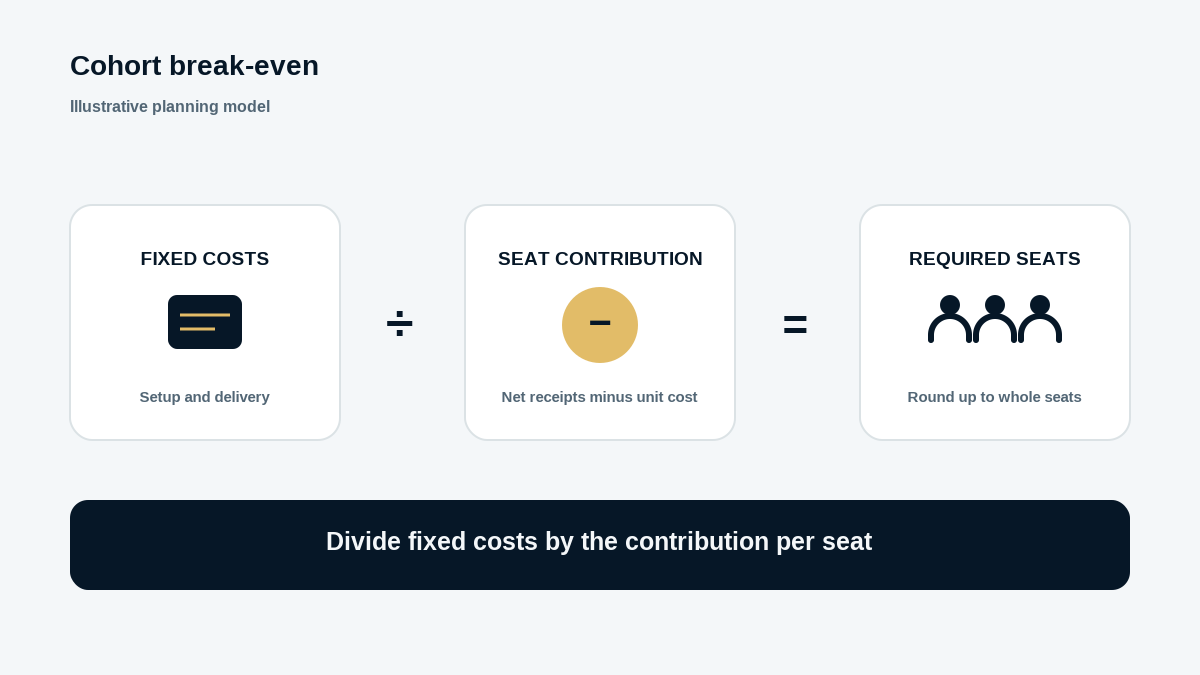
Minimum paid seats = fixed cohort costs ÷ (net receipts per seat − variable cost per seat), rounded up. That applies the unit break-even formula to a training cohort. If net receipts per seat do not exceed the variable cost, adding more learners on the same terms will not solve the problem.
| Item | Illustrative example |
|---|---|
| Fixed cohort costs | SAR 4,200 |
| Net receipts per seat | SAR 400 |
| Additional delivery cost per seat | SAR 50 |
| Contribution per seat toward fixed costs | SAR 350 |
| Minimum paid seats | 12 seats |
| Full-cost result at eight paid seats | −SAR 1,400 |
Calculate net receipts on a consistent basis: after discounts and fees you actually bear, and without treating tax collected for the authorities as income where applicable. Do not deduct payment fees from revenue and again as a variable cost. Distinguish costs attributable to this cohort from facility rent you will pay regardless. This is not the same as pricing your course and setting its margin, or measuring overall institute profitability.
Second decision: Which choice costs less from here?
At the cutoff, separate sums already paid and unrecoverable from costs you will incur only if you run the cohort. Compare the options from one baseline. In this example, SAR 1,200 is already spent and non-refundable out of the SAR 4,200 fixed cost. Running requires a further SAR 3,000 in fixed costs. We also assume a full refund to learners if canceled and an additional SAR 400 cancellation cost.
| Option | Change compared with refunding all eight learners | Result |
|---|---|---|
| Run with eight | Retain SAR 3,200 against SAR 3,000 future fixed costs and SAR 400 variable costs | −SAR 200 |
| Cancel | Retain no fees after refunding learners and pay SAR 400 more | −SAR 400 |
| Postpone | Compare verified expected revenue after confirmations with refunds, the cost of the new date, and remaining commitments from the original date | Needs its own inputs |
In this example, running is SAR 200 better financially than canceling. That does not make the cohort profitable after counting its full costs: running is −SAR 1,400 and canceling is −SAR 1,600. If you instead report bank movements from today and the fees have been collected, do not count the SAR 3,200 as a new receipt when running; that sum would appear only as a refund when canceling. Do not mix the two baselines in one comparison.
Cohort decision calculator
Default numbers are illustrative. Cancellation assumes a full refund to each learner and equal net receipts per seat. Compare running and deferral on the same basis.
Do not ask the calculator to make a quality decision
Before approving the financial choice, ask: Are there enough learners for the group work and practical exercises? Are the instructor and room ready? Do the date and delivery mode match what learners were promised and what the program requires? These are conditions of the decision, not boxes you can skip because the arithmetic is SAR 200 better. If you are considering changing delivery mode, consult the in-person, blended, and remote training guide before offering or confirming the alternative.
• Sales: Close the list with clear statuses: paid, link sent, inquiry, or withdrawn. If many people registered interest but few paid, check your team’s capacity to follow up on inquiries rather than assuming advertising was the only problem.
• Finance: Reconcile collections and refunds, and separate unrecoverable costs, cancellation obligations, and costs that change by option.
• Operations: Confirm room, instructor, assessments, and the alternative date. Record the owner and time of the final decision.
• Learner support: Explain the decision, choices, and dates in line with actual policies. Record confirmations instead of treating silence as consent.
After the decision, record what will help the next cohort
Track three separate numbers: bookings that did not pay, paid registrations that ended in a refund, and dates that were postponed or canceled. Add the verified reason and look for patterns over several cohorts. A single cohort does not establish weak demand or poor employee performance. The objective is to improve the next program decision, not to find someone to blame for this month’s results.
Today’s step: Pick an upcoming cohort. Ask finance how many seats are paid, ask operations for its decision cutoff, and collect the cancellation and postponement inputs by the end of the day. Then you can review the decision after it is made.