The training room is ready, you have a platform, and customers are asking for an online option. But start with a different question: What should learners be able to do by the end of the course, and how will you know they can do it?
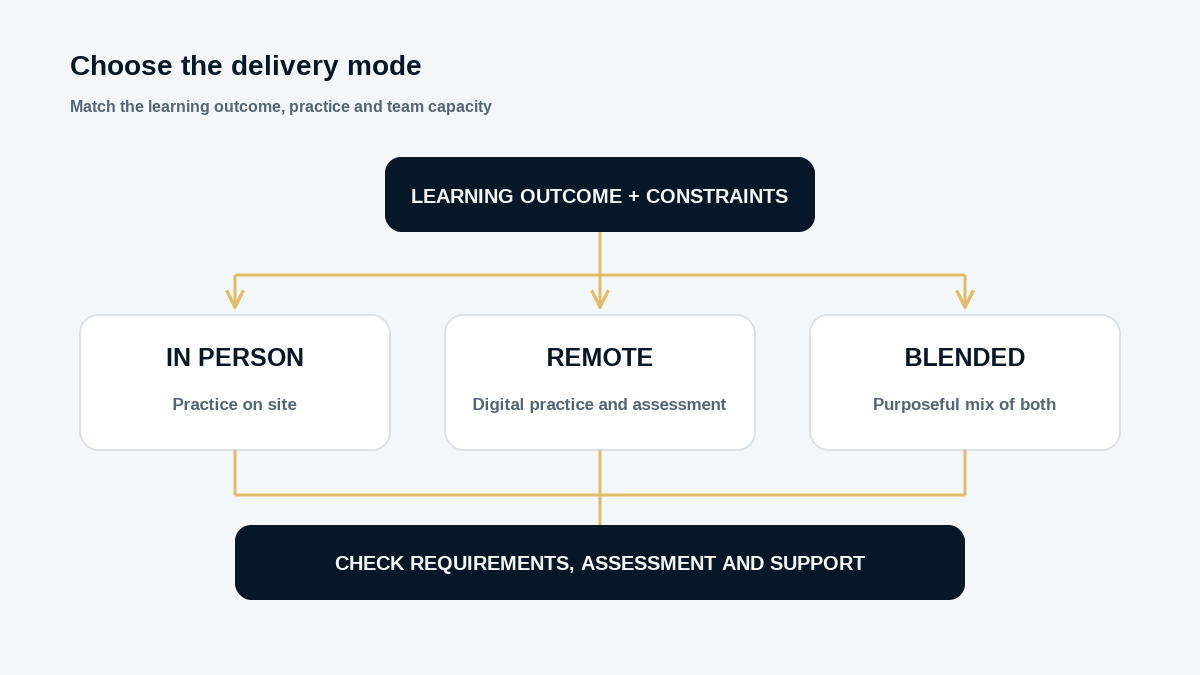
If the skill calls for equipment, direct observation or a setting that’s hard to reproduce, assess the in-person option first. If learners can study the theory remotely but need to practise in person, consider a blended course. If they can practise, be assessed and get adequate support remotely, test an online format. Whichever you choose, verify the program’s approval route and delivery format before advertising or opening registration.
Separate the facility licence, the program and how you deliver it
| What to check | Question to answer |
|---|---|
| Facility | Is our facility licence valid, and does it cover this activity? |
| Program | Has this program completed the process required for its category by the relevant authority? Does it match the description and hours you present to learners? |
| Delivery format | Can the program be offered in this format, and have we met the applicable online delivery requirements? |
The Technical and Vocational Training Corporation (TVTC) distinguishes between applying for a new training facility licence and applying to activate training programs for that facility. You can look up licensed facilities and approved programs through the TVTC verification service. If the lookup or program documents don’t clearly identify the delivery format, check with the relevant authority rather than assuming permission for in-person delivery also covers blended or online training.
What changed for private-sector online training?
On 25 March 2026, the National eLearning Center (NeLC) announced a unified licensing process for private-sector online education and training programs in coordination with TVTC, beginning in May 2026. Under the announced process, providers it applies to can obtain the program licence from TVTC after meeting the technical integration requirements for NeLC’s systems through FutureX, the national eLearning platform. The streamlined process does not remove integration requirements, standards or NeLC oversight.
The eLearning Regulations and their Implementing Rules provide the general framework for online delivery. Don’t treat the unified process as a blanket exemption or assume an older procedure still applies unchanged. If you are launching a diploma or a program with sector-specific requirements, or changing the delivery format of an existing program, confirm the current process for your case before committing to a launch date.
Decision matrix: Where will learners learn best?
| Format | Favour it when… | Check before deciding |
|---|---|---|
| In person | Practice depends on equipment or a training situation that needs close guidance | The room and equipment can support the group, the trainer can observe each learner, and you can sell enough places locally |
| Blended | You can separate instruction from practice without disrupting how learners build the skill | Identify which hours are in person and which are remote, and who will oversee the transition and assess learners in both parts |
| Online | Learners are geographically dispersed, and they can practise the skill and be assessed digitally | Test access, interaction, submissions and support. Choose live sessions or asynchronous content based on what learners need to do and who they are |
Using technology does not automatically make a course blended. Uploading revision notes for an in-person course isn’t the same as replacing some of its hours with remote lessons. That distinction follows from the definitions in Article 2 of the Implementing Rules. Don’t apply a single hours threshold to every program. Document the split and verify the classification for your program.
Example: An Excel course for administrative teams
Suppose learners need to build a report from a data file and explain what the figures mean:
• In person: Learners work through the case in the room, where the trainer can spot who struggles with cleaning the data or building the report.
• Blended: Teach the basics and assign warm-up exercises online, then use an in-person workshop to solve the case and review the reports. Don’t reteach the same material in the workshop.
• Online: Learners complete a workbook outside the session, then get a live review or written feedback against published assessment criteria. Test software and file compatibility before choosing this route.
The learning outcome is the same, but how learners practise and demonstrate it changes. If you can’t assess performance properly online, don’t choose that format just because it’s easy to book a platform.
Before opening registration, check five things
1. Learning outcome: Write down one task learners can demonstrate or submit, not a broad aim such as “understand the basics.”
2. Compliance: Record the facility licence status, the program’s required process and the delivery format you’ve verified. Assign someone to follow up, and don’t advertise an approval you haven’t received.
3. Learner experience: Walk through registration, login, submission and assessment with your team. Check support and accessibility for your audience. Use the official eLearning Standards when designing the online component.
4. Cost: Budget for the room or platform, trainer, supervision, support, and creating and updating content. Compare cost per cohort using realistic enrolment, not maximum capacity.
5. Staff capacity: Identify who answers questions before registration, who handles access issues during the course, and who reviews assignments afterwards. If no one owns these tasks, a larger cohort may make the problem worse.
If you’re still deciding whether to launch the course at all, start with our training course launch decision guide. If you’ve chosen the format and need to check whether your enrolment team can keep up, see our guide to sales team capacity for training enquiries.
If your course materials are still under review or being updated, see the guide to preparing training materials for approval.
Marktone can help you design training materials, develop content and source trainers, or set up enrolment, training delivery and the systems that support them. Tell us the program type, the learning outcome and the format you’re considering. We can help prepare delivery and review requirements; approvals are issued by the relevant authorities.
Official sources reviewed on 21 November 2026. This is a planning guide, not a substitute for verifying the requirements for your facility and program before launch.